
Use the spectral information from pure samples in the endmembers to create objects from the expression criteria for segmentation.
Parameters
Method
Use one of the following regression methods to compare the end members spectrum to the measurements:
-
None Negative Least Squares
-
Sum To One Least Squares
Scatter correction
Select one of the options below
-
None
-
No scatter correction applied.
-
-
Baseline
-
A constant scatter correction is applied.
-
-
Slope
-
A linear scatter correction is applied.
-
-
Parabola
-
A quadratic scatter correction is applied.
-
Expression (Optional)
To include extra expression.
Expression
Write in the expression you want to apply. The following comparators can be used for the expression:
Operators than can be used expressions include the data operators wNNN and bMMM for referring to wavelength bands, the range operator : used for averaging data, standard arithmetic (+,-,/,* …) and comparison operators (=,>,< …) as well as some mathematical functions (
'%3e%3cg transform='translate(167%2c0)'%3e%3cg transform='translate(-13%2c0)'%3e%3cg transform='translate(0%2c-109)'%3e%3cuse xlink:href='%23MJMAIN-221A' x='0' y='55'%3e%3c/use%3e%3crect stroke='none' width='750' height='60' x='833' y='796'%3e%3c/rect%3e%3cuse xlink:href='%23MJMAIN-4E' x='833' y='0'%3e%3c/use%3e%3c/g%3e%3c/g%3e%3c/g%3e%3c/g%3e%3c/svg%3e) …) and constants (
…) and constants (
).
Breeze does not validate the provided expression until you click Apply changes to apply it to some data.
|
Data Operator |
Description |
|---|---|
|
|
Wavelength lookup operator that finds the wavelength band closest to the provided number A setting controls how far off a wavelength is allowed to be to be considered a match. If there isn’t matching data an error is displayed when applying the workflow to data. Learn more in Wavelength matching. Example of this syntax: |
|
|
Band index operator. If the index |
|
|
Average range operator that returns the average value for a range of wavelength bands. For example: |
Expand to see all available operators
|
Arithmetic Operator |
Description |
|---|---|
|
|
Subtract |
|
|
Add |
|
|
Divide |
|
|
Multiply |
|
|
Modulo |
|
|
Raised to a power |
|
Comparison Operator |
Description |
|---|---|
|
|
Equal to |
|
|
TRUE if any of the conditions separated by OR is TRUE |
|
|
TRUE if all the conditions separated by AND is TRUE |
|
|
Not equal to |
|
|
Less than |
|
|
Less than or equal to |
|
|
Greater than |
|
|
Greater than or equal to |
|
Function operator |
Description |
|---|---|
|
|
|
|
|
|
|
|
|
|
|
|
|
|
|
|
|
|
|
|
|
|
|
|
'%3e%3cg transform='translate(167%2c0)'%3e%3cg transform='translate(-13%2c0)'%3e%3cg transform='translate(0%2c-50)'%3e%3cuse xlink:href='%23MJMAIN-73'%3e%3c/use%3e%3cuse xlink:href='%23MJMAIN-69' x='394' y='0'%3e%3c/use%3e%3cuse xlink:href='%23MJMAIN-6E' x='673' y='0'%3e%3c/use%3e%3cuse xlink:href='%23MJMAIN-4E' x='1396' y='0'%3e%3c/use%3e%3c/g%3e%3c/g%3e%3c/g%3e%3c/g%3e%3c/svg%3e)
'%3e%3cg transform='translate(167%2c0)'%3e%3cg transform='translate(-13%2c0)'%3e%3cg transform='translate(0%2c-50)'%3e%3cuse xlink:href='%23MJMAIN-63'%3e%3c/use%3e%3cuse xlink:href='%23MJMAIN-6F' x='444' y='0'%3e%3c/use%3e%3cuse xlink:href='%23MJMAIN-73' x='945' y='0'%3e%3c/use%3e%3cuse xlink:href='%23MJMAIN-4E' x='1506' y='0'%3e%3c/use%3e%3c/g%3e%3c/g%3e%3c/g%3e%3c/g%3e%3c/svg%3e)
'%3e%3cg transform='translate(167%2c0)'%3e%3cg transform='translate(-13%2c0)'%3e%3cg transform='translate(0%2c-74)'%3e%3cuse xlink:href='%23MJMAIN-65' x='0' y='0'%3e%3c/use%3e%3cuse transform='scale(0.707)' xlink:href='%23MJMAIN-4E' x='628' y='513'%3e%3c/use%3e%3c/g%3e%3c/g%3e%3c/g%3e%3c/g%3e%3c/svg%3e)
'%3e%3cg transform='translate(167%2c0)'%3e%3cg transform='translate(-13%2c0)'%3e%3cg transform='translate(0%2c-50)'%3e%3cuse xlink:href='%23MJMAIN-6C'%3e%3c/use%3e%3cuse xlink:href='%23MJMAIN-6E' x='278' y='0'%3e%3c/use%3e%3cuse xlink:href='%23MJMAIN-4E' x='1001' y='0'%3e%3c/use%3e%3c/g%3e%3c/g%3e%3c/g%3e%3c/g%3e%3c/svg%3e)
'%3e%3cg transform='translate(167%2c0)'%3e%3cg transform='translate(-13%2c0)'%3e%3cg transform='translate(0%2c-21)'%3e%3cuse xlink:href='%23MJMAIN-6C'%3e%3c/use%3e%3cuse xlink:href='%23MJMAIN-6F' x='278' y='0'%3e%3c/use%3e%3cuse xlink:href='%23MJMAIN-67' x='779' y='0'%3e%3c/use%3e%3cg transform='translate(1279%2c-243)'%3e%3cuse transform='scale(0.707)' xlink:href='%23MJMAIN-31'%3e%3c/use%3e%3cuse transform='scale(0.707)' xlink:href='%23MJMAIN-30' x='500' y='0'%3e%3c/use%3e%3c/g%3e%3cuse xlink:href='%23MJMAIN-4E' x='2253' y='0'%3e%3c/use%3e%3c/g%3e%3c/g%3e%3c/g%3e%3c/g%3e%3c/svg%3e)
'%3e%3cg transform='translate(167%2c0)'%3e%3cg transform='translate(-13%2c0)'%3e%3cg transform='translate(0%2c-159)'%3e%3cuse xlink:href='%23MJMAIN-4E' x='24' y='0'%3e%3c/use%3e%3cg transform='translate(0%2c500)'%3e%3cuse transform='scale(0.707)' xlink:href='%23MJMAIN-AF' x='-70' y='0'%3e%3c/use%3e%3cg transform='translate(209.06654848801062%2c0) scale(0.940075563880908%2c1)'%3e%3cuse transform='scale(0.707)' xlink:href='%23MJMAIN-AF'%3e%3c/use%3e%3c/g%3e%3cuse transform='scale(0.707)' xlink:href='%23MJMAIN-AF' x='630' y='0'%3e%3c/use%3e%3c/g%3e%3c/g%3e%3c/g%3e%3c/g%3e%3c/g%3e%3c/svg%3e)
'%3e%3cg transform='translate(167%2c0)'%3e%3cg transform='translate(-13%2c0)'%3e%3cg transform='translate(0%2c-24)'%3e%3cuse xlink:href='%23MJMAIN-230A' x='0' y='0'%3e%3c/use%3e%3cuse xlink:href='%23MJMAIN-4E' x='611' y='0'%3e%3c/use%3e%3cuse xlink:href='%23MJMAIN-2309' x='1361' y='0'%3e%3c/use%3e%3c/g%3e%3c/g%3e%3c/g%3e%3c/g%3e%3c/svg%3e)
|
Constants |
Description |
|---|---|
|
|
Always evaluates to TRUE |
|
|
Always evaluates to FALSE |
|
|
|
|
|
|
Example: (Filename of end member 1) > 1 | (Filename of end member 2) < 0.5
Range
Write in the wavelength range to use. If left empty all wavelengths are included.
End Members (1-10)
Select files containing End members for each pure sample.
Min area
The minimum number of pixels for an object to be included.
Max area
The maximum number of pixels for an object to be included.
If 0 no maximum area is defined.
Object filter
Use an expression to further exclude unwanted objects based on shape.
Properties that can be used for the Expression:
-
Area -
Length -
Width -
Circumference -
Regularity -
Roundness -
Angle -
D1 -
D2 -
X -
Y -
MaxBorderDistance -
BoundingBoxArea
For details on each available property see: Object properties Details
Shrink
Takes away
numbers of pixels at the borders of the objects included in images.
Separate
The Separate parameter defines how pixels that pass your segmentation threshold are grouped into distinct object samples.
Pixel connectivity
Breeze uses 8-connectivity. Pixels are considered connected if they touch horizontally, vertically, or diagonally on a single corner.
1. Normal
-
Behavior: Standard connected-component grouping.
-
Result: Pixels touching by an edge or corner form a single object. Physically isolated clusters form separate objects.
2. Separate adjacent objects
-
Behavior: Applies a distance transform to find the inner centers (geometric peaks) of pixel clusters, then splits them using a watershed-style growth algorithm.
-
Best Used For: Round or spherical objects that are touching or overlapping.
-
Limitation: Elongated, branched, or irregular shapes may be incorrectly split into multiple objects because the algorithm detects multiple internal peaks within a single physical item.
3. Merge all objects into one
-
Behavior: Disregards spacing; combines all valid pixels across the entire image.
-
Result: Evaluates the entire frame as one single object for collective regional analysis.
4. Merge all objects per row
-
Behavior: Groups detected objects based on the spatial grid of their vertical center points (Y-coordinates).
-
Result: All objects residing within the same horizontal row lane are merged into a single object.
5. Merge all objects per column
-
Behavior: Groups detected objects based on the spatial grid of their horizontal center points (X-coordinates).
-
Result: All objects residing within the same vertical column lane are merged into a single object.
Link
Only visible when applicable
Link output objects from two or more segmentations to top segmentation. Descriptors can then be added to the common object output and will be calculated for objects from all segmentations.
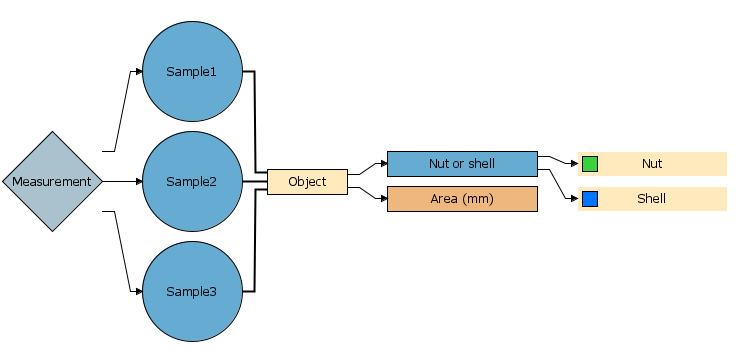
The segmentations must be at same level to be available for linking.