
We are pleased to announce the latest release of the Breeze, version 2026.2! This update delivers advancements designed to maximize operational efficiency, analytical accuracy, system stability, and everyday user productivity across laboratory, industrial, and continuous production environments. By integrating automated calibration workflows, embedding a zero-configuration Python environment, expanding hardware automation, and modernizing the user interface, Breeze is now better than ever before.
If you’re new to Breeze, refer to the Prediktera web site to learn about the benefits: Breeze Suite - Prediktera.
Highlights
-
Dedicated White-Reference & Post-Measurement Dark Correction: Integrated post-scan dark references, dedicated White-Reference dark corrections.
-
Embedded Python Runtime: Out-of-the-box custom scripting and descriptor execution with zero manual environment configuration, automated permission management, and resilient fallbacks.
-
USGS PRISM MICA: Improvements
-
Optimized Real-Time & Machine Learning: Boosted throughput and minimized memory overhead for streaming Principal Component Analysis and deep learning (
ONNX Runtime) inference during continuous prediction. -
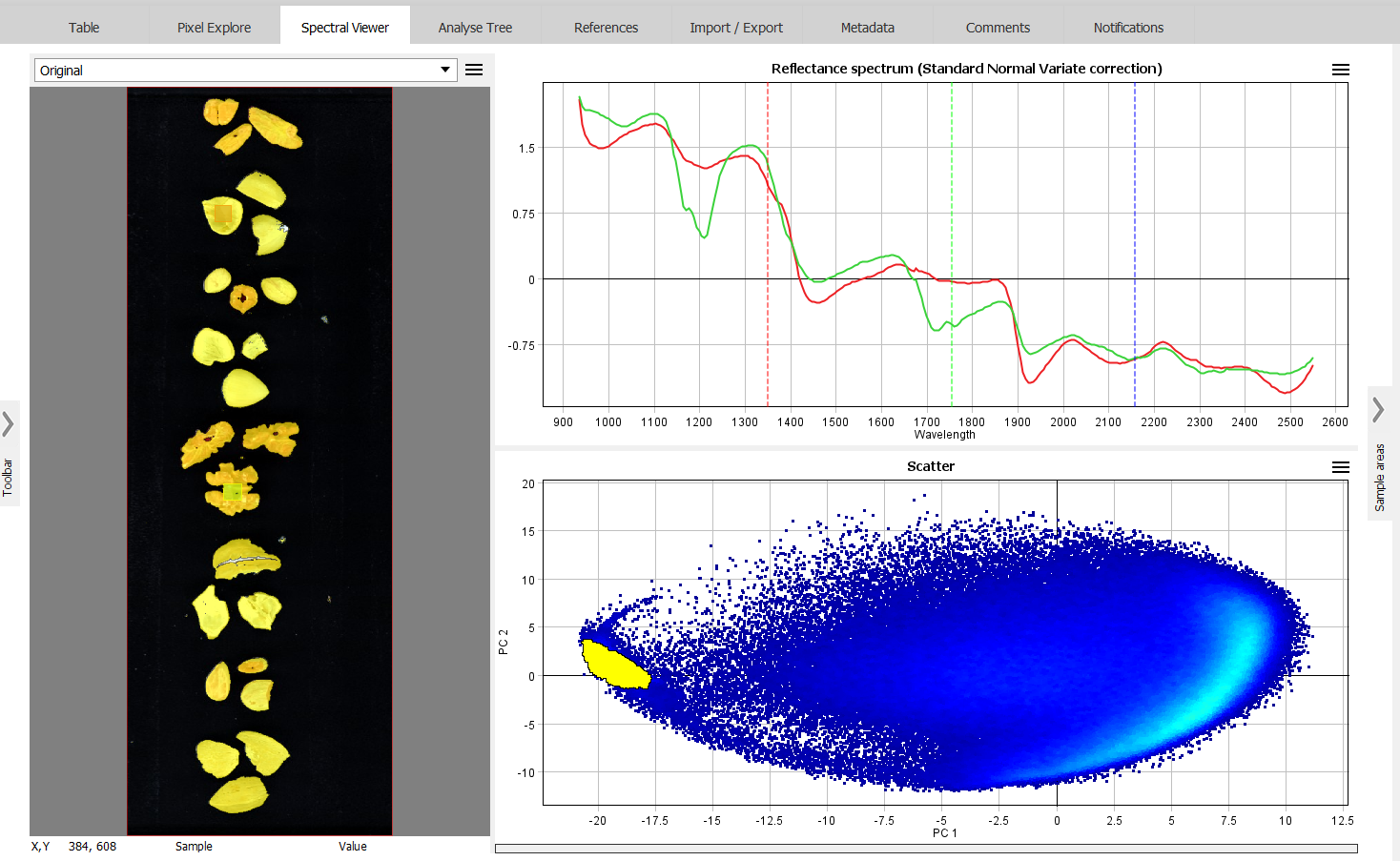
Spectral viewer:
PCAdirectly accessible within the spectral viewer.
Learn more about these and other changes in Breeze below, grouped by area functionality.

Record - Breeze common features
This section is about the core functionality of Breeze for data acquisition and data management.
-
Dedicated White-Reference & Post-Measurement Dark Correction: Added specialized workflows for capturing dark reference frames immediately after scans and taking dark corrections specific to white reference calibration tiles (
WR Dark). This compensates for sensor temperature fluctuations and ambient illumination shifts over extended operational cycles. -
Disk-Cached Reference Storage: References can now stream and persist directly on disk rather than occupying system memory, significantly reducing RAM footprint.
-
Multi-Camera Balancing: Refined frame-averaging algorithms across synchronized multi-camera setups.
-
Header Metadata: Records measurement names, comments into
ENVIheader. -
Prediktera Data Server: Added snapshot support.
Hardware
-
Integrated automatic calibration system: Integrated motorized positioning routines for the HySpex modular industrial housing.
-
Resonon: Upgraded camera drivers.
-
Basler: Upgraded camera drivers and additional information fetching for metadata.
-
IDS: Upgraded camera drivers.
-
Haip: Increased parity to Blackstudio.
User interface
-
Dynamic Legend & Range Adjustments: Introduced customizable minimum/maximum dialog panels and clear legend titles for quantitative predictions, allowing operators to fine-tune visual contrasts without altering underlying data.
-
Visual Clarity & Clear Controls: Upgraded the interface styling with interactive hover states on checkboxes, modernized radio buttons, and clearer action labels.
-
Improved error handling: Added warning dialogs and improved error handling

Analyze
Improvements for data analysis in Breeze.
-
Standard Mathematical Operator Precedence: Updated the runtime polynomial and expression parser.
-
Machine Learning Inference: Optimized memory buffers for deep learning (
ONNX Runtime) execution. -
Boundary-Aware Object Metrics: Real-time segmentation routines to reliably compute geometric properties.
-
Compressed TIFF Support: Added handling for compressed TIFF formats during import.
-
Combine properties improvements: None existing properties are no longer considered zero during calculations. Combine properties
-
PCA: PCA model in Analyse tree is now using the memory efficient implementation.
Python
-
Embedded Mamba Python Runtime: Breeze now ships with an embedded, pre-configured Python environment.
-
Streaming Descriptor Interface: Standardized script execution around modern streaming interfaces, eliminating disk I/O bottlenecks and enabling immediate execution on streaming pixel arrays and segmented objects.
-
Added a Python pixel prediction descriptor and worker
-
New descriptor: Python classification (descriptor)
-
Renamed descriptor “Python Script” to Python numerical
-
Renamed segmentation “Python Script” to Python segmentation
-

Optional module: Geological analysis
-
USGS PRISM MICA & Mineral Identification Parity: Enhanced the numerical precision of continuum removal calculations, aligned absorption band matching with standard
ENVIreference libraries, and introduced ranked candidate material matching. USGS PRISM MICA -
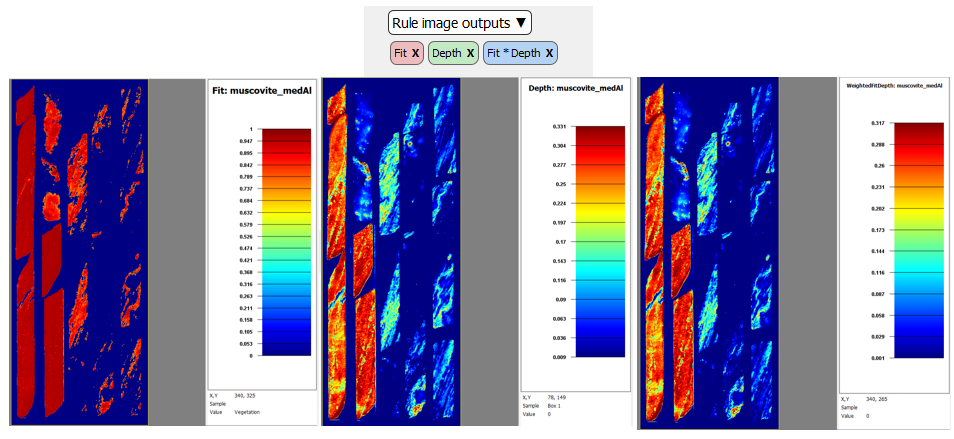
USGS PRISM MICA generated statistics: Enable extraction of per pixel maps for fit, depth and “fit x depth” maps. USGS PRISM MICA
Other changes
-
Batch Bad-Pixel Correction: Added capabilities to automatically detect and apply bad-pixel corrections across entire measurement folders and during dark reference extraction to eliminate sensor artifacts from downstream models.
-
Header-Based Reference Extraction: Streamlined extracting dark reference information directly from HySpex binary headers.
-
Fluid Viewport & Tree Navigation: Added smooth mousewheel scrolling in the Analysis tree and reduced jitter during image scrolling.
-
Forced OS Disk Flushing: Implemented direct buffer flushing when writing hypercube files to disk.
-
Real-Time Connection Resilience: Eliminated interface stalls during connection drops with Breeze Runtime
-
Spectral viewer:
PCAdirectly accessible within the spectral viewer. -
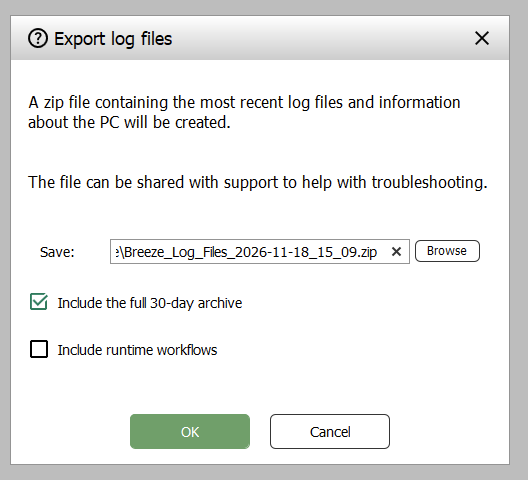
Diagnostic Log Export: Added an export panel with customizable target directories to package system logs.